
Straighten Up: Real-World Ways to Fix Your Posture and Reduce Strain
Good posture isn’t about standing like a soldier or balancing a book on your head. It’s about alignment — how your muscles, joints, and spine cooperate to hold you upright with the least stress possible. When alignment slips, pain creeps in: neck tension, tight hips, sore shoulders, even headaches.
Here’s a simple truth: posture is trainable. With practice, awareness, and the right routines, your body learns to stack itself efficiently again.
Quick Take — What You’ll Gain
Before diving into details, here’s what a posture-tune-up actually delivers:
- Less fatigue — efficient muscles work smarter, not harder.
- Fewer aches — reduced strain in the neck, shoulders, and lower back.
- Better breathing — open ribs allow deeper, steadier inhalation.
- Confidence boost — upright posture subtly changes how you feel.
Start With Awareness
Every improvement begins with noticing. Spend a day checking in:
- When you’re at your desk, are your shoulders forward?
- When scrolling on your phone, is your head tilted down?
- When you stand, does your weight shift to one leg?
Awareness doesn’t require correction yet; it’s just gathering data. Once you recognize patterns, change becomes easier.
Build Strength in the Right Places
Muscles that support posture — particularly in your back and core — act like guy wires on a tent. Strengthen them, and alignment follows.
Target zones:
- Upper back (rhomboids, rear deltoids) — counteracts slouching.
- Core (deep abdominals) — stabilizes spine.
- Glutes — anchor the pelvis and relieve low-back load.
Sample Weekly Mix
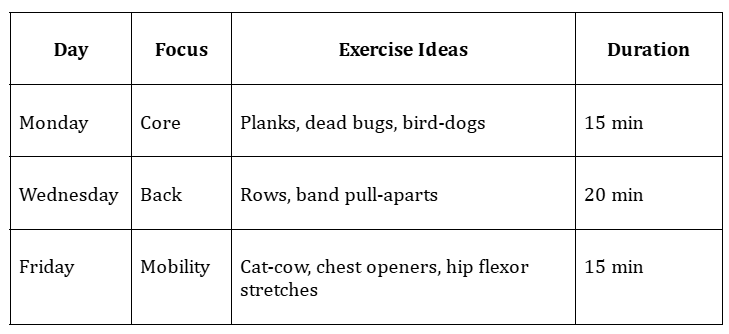
Keep sessions short but consistent; posture improves from repetition.
Redesign Your Workspace (or Couch Space)
Poor posture often reflects poor setup. A quick checklist:
✅ Monitor at eye level.
✅ Keyboard and mouse close to elbows, not shoulders.
✅ Feet flat on the floor (use a small box if needed).
✅ Chair back supports the curve of your spine.
✅ Screen break every 30–45 minutes.
Even the perfect ergonomic chair can’t fix hours of stillness, so stand up, stretch, and reset posture throughout the day.
Movement Snacks: Mini-Habits That Fix Slouching
Tiny, repeatable motions strengthen the “memory” of good posture.
Try these quick hits between tasks:
- Shoulder blade squeezes × 10.
- Chin tucks (gently draw head back).
- Door-frame chest stretch, 30 seconds.
- Stand up whenever you hit “send” on an email.
Checklist — Five-Minute Daily Reset
- Sit tall, feet grounded.
- Roll shoulders back and down.
- Inhale to widen ribs; exhale slowly.
- Engage lower abs for support.
- Imagine a string lifting the crown of your head.
Repeat morning, mid-day, evening.
When to Add Tools or Support
Sometimes you need feedback to retrain alignment. Foam rollers, posture corrector braces, or simple mirror checks help you sense imbalance. A professional massage can also loosen tight fascia that pulls you off-center.
For example, By Grace Massage offers targeted sessions for postural restoration and movement education — blending deep-tissue work with awareness coaching so your muscles learn the “feel” of upright support.
Customize Your Routine (and Streamline It)
Many people gather dozens of posture PDFs or exercise guides and quickly drown in options. If you’ve compiled a long digital guide and want to simplify, consider trimming irrelevant sections before printing or sharing. You can easily delete pages from PDFs to remove duplicates or off-topic routines — keeping only what fits your goals. A tidy reference is far more motivating than an overwhelming one.
The Social Side of Standing Tall
Posture isn’t purely physical. Emotional state and self-image influence how you hold yourself. Stress tends to make people fold inward; calm confidence opens the chest. Practices such as yoga, tai chi, or mindful walking integrate body awareness with breath and mood — powerful allies for posture improvement.
FAQs — Common Posture Questions
Is “perfect” posture realistic?
No. Your body constantly shifts. Think “balanced” rather than rigid. Dynamic posture — gentle micro-adjustments — keeps tissues healthy.
How long until I see changes?
Most people feel less tension within two weeks of consistent practice; visible alignment changes follow in 4–6 weeks.
Do I need expensive gear?
Not at all. A good resistance band, a wall, and mindful repetition outperform any gadget when used consistently.
Can poor posture really cause headaches?
Yes. Forward-head position strains neck muscles that attach near the skull. Correcting it often reduces tension headaches.
A Short Reflection to End On
Good posture is a living conversation between awareness, movement, and rest. You don’t need military precision — just curiosity. Notice, adjust, repeat. Over time, the upright stance you practice becomes your default, not your chore.
Hold yourself kindly, not rigidly. Every gentle correction is a small act of self-care — one that your spine, muscles, and mood will thank you for.
Author: Brad Krause
Leave A Comment